
With the 40kWh battery and 65kW faster charging, it is now a legitimate primary car for a small family that can handle weekend trips easily, says Rajesh Karkera.

Tata Motors on Wednesday launched its Tiago EV with introductory prices for first 10,000 customers ranging between Rs 8.49-11.79 lakh

India's electric passenger vehicle market saw an 87.4 per cent year-on-year increase in FY26, reaching 233,246 units, primarily driven by the mid-size SUV segment (20-30 lakh price bracket), while the entry-level segment (sub-10 lakh) experienced a decline.

If you thought the Tata Nexon EV was it, wait till you drive the new Tata Nexon EV Max with more battery power, says Rajesh Karkera. Photographs and video: Hitesh Harisinghani/Rediff.com.

Tata Motors is looking to ramp up the production of electric vehicles as demand continues to outpace the manufacturing activity by a huge margin, according to a top company official. The Mumbai-based automaker, which led the passenger electric vehicle space in the domestic market in last fiscal year, has been receiving an average of 5,500-6,000 bookings in the past two months for its EV range. The company sells three electric products -- Nexon EV, Tigor EV and XPRES-T -- in the domestic market.

Tata Motors surpassed Maruti Suzuki (India) (MSIL) to become the most-valuable automobile company, in terms of market capitalisation (mcap), after a gap of seven years. With this, the company's stock hit a new high on the BSE on Tuesday (January 30). The combined mcap of Tata Motors (Rs 285.51 crore) and Tata Motors DVR (Rs 29,119 crore) stood at Rs 3.146 trillion.
Tata Motors, India's largest electric passenger vehicle manufacturer, has signed an agreement with ride-hailing company Uber to supply 25,000 electric vehicles (EVs), the company said. The agreement is the largest EV commitment between an automotive manufacturer and a ride-sharing platform in India. Under the agreement, Uber will deploy Tata Motors' XPRES-T EVs by partnering fleet operators in Delhi National Capital Region, Mumbai, Kolkata, Chennai, Hyderabad, Bengaluru, and Ahmedabad.

'Favourable product mix, sales recovery, and cost saving initiatives are expected to support margins going ahead while focus on debt reduction (target of debt free by FY24) will aid balance sheet strength'

JSW Motors, part of the JSW group, is set to enter India's passenger vehicle market with plans to launch 15 new-energy vehicles (NEVs) over the next four years, with deliveries commencing from December 2026.
Tata Motors plans to have 10 new battery electric vehicles (BEVs) in its domestic product portfolio by 2025 as it looks to drive its business model towards sustainable mobility going ahead, as per Tata Motors chairman N Chandrasekaran. In his message to the shareholders, he noted that the auto major aims to be amongst the world leaders in sustainable mobility solutions and as part of that it is also exploring tie-ups in cell and battery manufacturing to secure supplies for its portfolio of green vehicles. "In India, EV penetration in our portfolio has now doubled to 2 per cent this year and we expect penetration to increase exponentially in the coming years. "Tata Motors will lead this change in the Indian market. By 2025, Tata Motors will have 10 new BEV vehicles and as a Group, we will invest proactively to set up charging infrastructure across the country," Chandrasekaran informed shareholders in the company's Annual Report for 2020-21.

Recently, TPEM's first born electric concept, Avinya broke cover. The model promises a minimum range of 500 kilometres and advanced technology features, aimed at buyers in India and outside. TPEM, the newly formed entity may also consider a separate dedicated sales channel for the EVs with a distinctive corporate identity once the volumes reach a critical mass and throughput is large enough for the dealers to be profitable, said Chandra. Elaborating further on the hiring strategy he said, "We will hire from everywhere-wherever the talent of the required competency is available."
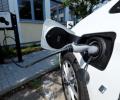
Tata Motors is planning to invest Rs 15,000 crore in the EV segment in the next five years, a top company official has said. The company, which is a leader in the newly emerging EV segment with offerings such as Nexon, is also planning to develop around 10 more new offerings in the segment, president for Passenger Vehicles Business of Tata Motors Shailesh Chandra said. "As far as future is concerned, in next five (years) we will invest Rs 15,000 crore in electrification.

Tata Motors' MD and CEO, Girish Wagh, has identified rising diesel prices as the most significant threat to India's commercial vehicle (CV) industry recovery, despite the sector recently surpassing its pre-FY19 wholesale peak. Diesel costs account for 25-50% of a truck operator's total cost of ownership, making any increase a critical concern for fleet economics.
Tata Passenger Electric Mobility (TPEM), a subsidiary of Tata Motors, on Friday announced that it has commenced production at its second factory in Sanand, Gujarat, which it had acquired from Ford India last year. This new facility will unlock an additional manufacturing capacity of 300,000 units per annum, which is scalable to 420,000 units. The new facility is spread over 460 acres and is adjacent to Tata Motors' existing passenger vehicle facility in Sanand.
There is no impediment to normal operations as Tata Motors puts in place the demerger process of its commercial and passenger vehicles businesses. Instead, the demerger would provide greater manoeuvrability for both new entities to operate independently, according to Tata Motors management. While there may not be immediate value unlocking, it will give investors clarity about future growth and the financials across different segments.

The Delhi government has approved the Delhi EV Policy 2.0, which will phase out fresh registrations of internal combustion engine (ICE) two-wheelers and three-wheelers over the next two years, starting with a ban on ICE 3Ws and N1 category LCVs from January 1, 2027, and ICE 2Ws from April 1, 2028.
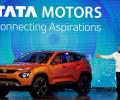
Notwithstanding robust volume growth and a strong performance from Jaguar Land Rover (JLR), Tata Motors, the country's second-largest automobile (auto) manufacturer by market capitalisation, disappointed the Street with its January-March quarter (Q4) results for 2023-24 (FY24). While consolidated revenues saw a 13 per cent increase, lower-than-expected realisations in the Indian operations weighed down overall performance.

Frankly, I never expected to be offroading in an electric vehicle, let alone an SUV of this calibre, raves Rajesh Karkera/Rediff after a test drive.

Food delivery and quick commerce (qcom) service application (app), Zomato, now commands a market capitalisation (mcap) higher than automobile giants Tata Motors and Bajaj Auto. Zomato, whose shares closed 1.18 per cent lower on Thursday at Rs 288.45 per share, has an mcap of Rs 2.78 trillion, according to BSE data. By comparison, Tata Motors' mcap stood at Rs 2.74 trillion, while Bajaj Auto's was Rs 2.5 trillion on the BSE.

Tata Motors recently announced the launch of 'Dark' edition models of the Harrier, the Nexon, the Nexon EV and its premium hatchback, the Altroz. The 'Dark' editions add a premium touch to its existing models. In 2019, Tata Motors launched the Harrier in its 'Dark' avatar to customers looking for a bold, sophisticated and stylish SUV.

As battery prices drop, early customers of Tata Motors, which was the first mover in the passenger EV market, could feel let down.
Tata Motors group's investment for this fiscal is pegged at Rs 28,900 crore, mostly for its British arm Jaguar Land Rover (JLR), company chairman N Chandrasekaran said on Friday. The company will also look to raise capital separately for its electric vehicles (EV) business at an appropriate time. It is looking to have 25 per cent of its sales coming from EVs in the medium to long term, up from 2 per cent at present, he said while addressing the company's virtual AGM.
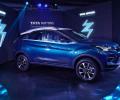
After clocking losses for seven straight quarters, Tata Motors on Wednesday posted a consolidated net profit of Rs 3,043 crore in the third quarter (Q3) of 2022-23. This came on the back of a strong order book, better semiconductor chip supply, tempered commodity prices, and a better product mix. "We remain cautiously optimistic about the demand situation, notwithstanding the global uncertainty.
Tata Motors, the market leader in electric four-wheeler space, has sought incentives for its Tiago EV under the government's production-linked incentive (PLI) scheme, group chief financial officer P B Balaji said on Tuesday. The Mumbai-headquartered firm has applied for all variants of the Tiago, which recently hit a sales milestone of 10,000 units. "The Automotive Research Association of India certification is done.

Tata Harrier.ev versus Mahindra BE.06 versus Mahindra XEV.9E -- which one should you buy? Rajesh Karkera offers a checklist of features to influence your decision.
Tata Motors is looking to increase passenger vehicle prices from next month in order to make its model range compliant with stricter emission norms which kick in from April 1 next year, according to a top company official. In an interaction with PTI, Tata Motors Managing Director - Passenger Vehicle and Electric Vehicles Shailesh Chandra said the price revision would also offset the impact of commodity prices, which have remained high for the most part of the year. "The regulatory change will have its impact on the cost. Even the real impact of softening of commodity prices is only going to come from next quarter and we still have the residual impact of the commodity escalation that we have seen during the year," Chandra said.

Indian carmakers, including Maruti Suzuki and Kia India, reported robust sales growth in May 2026, with both companies achieving their highest-ever monthly sales despite rising fuel prices. Maruti Suzuki's domestic sales surged to 1,93,535 units, while Kia India recorded 27,586 units, driven by strong demand in mini and compact segments and a shift towards electric and CNG vehicles.

Tata Motors on Monday said its subsidiary and Ford India have inked a pact with the Gujarat government to acquire FIPL's Sanand vehicle manufacturing plant. Tata Passenger Electric Mobility Ltd (TPEML) -- a subsidiary of Tata Motors -- and Ford India Pvt Ltd (FIPL) have today signed a memorandum of understanding (MOU) with the Gujarat government for the potential acquisition of FIPL's Sanand vehicle manufacturing facility, including land, buildings, vehicle manufacturing plant, machinery and equipment, Tata Motors said in a regulatory filing. The MoU also includes the transfer of all eligible employees of FIPL Sanand's vehicle manufacturing operations, subject to the signing of definitive agreements and receipt of relevant approvals, it added.

India's leading passenger vehicle manufacturers are significantly increasing investments and factory capacities, alongside planning major product launches for FY27, driven by strong confidence in sustained domestic demand growth despite global geopolitical tensions and supply chain risks.

Nissan Motor India aims to achieve a fourfold increase in domestic sales, targeting 100,000 units annually, and export another 100,000 vehicles from its Chennai plant by financial year 2027-28 (FY28), marking a significant revival of its presence in the Indian passenger vehicle market.

The transaction - the second one in less than a year - is seen as an effort to restore investor faith in the company following a dismal performance by its UK subsidiary, Jaguar Land Rover Automotive.
Under FAME-II, automakers provided subsidies to electric vehicle (EV) customers at the time of purchase, with the understanding that the government would reimburse the firms later.

Government schemes such as the PM E-Drive initiative, with allocations of around Rs 2,000 crore for charging points deployment, are helping accelerate rollout

The Tata Harrier.ev is a car that makes you feel safe and powerful within a luxurious cocoon, raves Rajesh Karkera/Rediff after a gruelling test drive.
The business will also see a change of guard. Shailesh Chandra, president of EV and corporate strategy, will replace Mayank Pareek as president of PV business, including EV, with effect from April 1. Pareek will be superannuating from the company after a six-year stint at the end of February 2021. Chandra and Pareek will work on transition over the next few weeks.
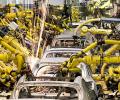
Passenger vehicle sales in India reached a record high of 4.7 million units in FY26, boosted by strong performances from major automakers and the implementation of GST 2.0.

Mahindra pushes premium EV strategy with XEV 9e Cineluxe, blending luxury design, immersive technology and over 500 km range capability.

Among the cars unveiled at the Auto Expo on Wednesday was Mahindra and Mahindra's e-KUV for Rs 8.2 lakhs ex-showroom Delhi. With a single charge range of 150 km and a 55 min fast charging upto 80 pc, it was both a head-turner and a conversation-starter.
Kerala has overtaken more industrialised states in personal electric vehicle adoption, driven by strong middle-class uptake, policy support, and charging infrastructure.

With the theme 'Smart Mobility, Smart Cities', the company's display at the Auto Expo is focusing on intelligently-connected cities designed to offer convenience, safety, security, and efficiency to its customers.
